
HCIS-qualified industrial security office
Arvox is an HCIS-qualified office — accredited by the High Commission for fire prevention and protection consultancy at oil, gas and industrial facilities.
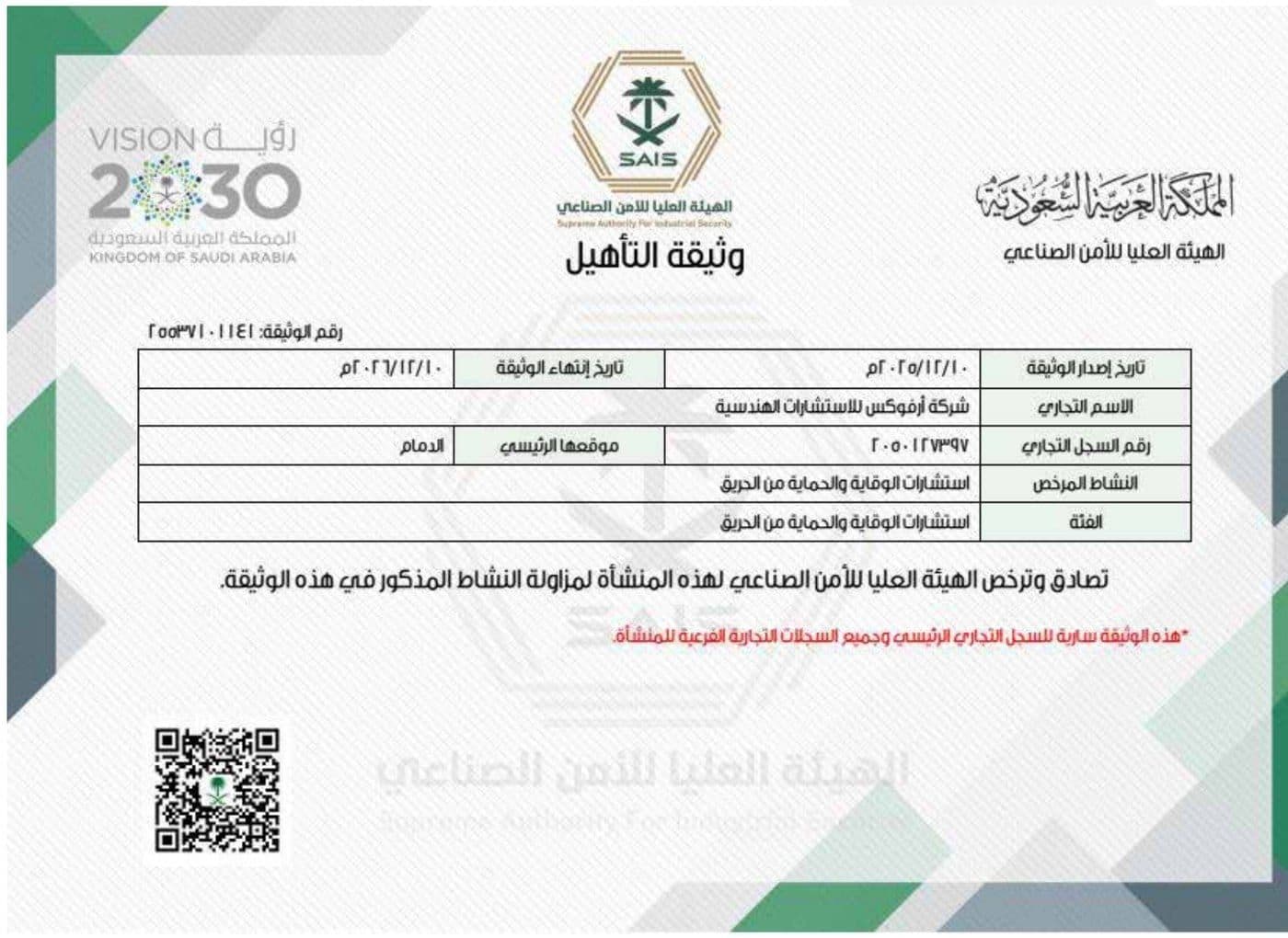
Accredited industrial-security office — HCIS qualification
Arvox is qualified by the High Commission for Industrial Security (HCIS) for fire prevention and protection consultancy — the qualification required to work on oil, gas and industrial facilities governed by HCIS directives, from risk studies to protection-system approval.
Facilities governed by HCIS directives require a qualified office before any technical proposal is accepted — Arvox holds that qualification for fire prevention and protection consultancy. We work with oil, petrochemical and industrial facilities in Jubail, Dammam and across the Eastern Province: from hazard studies and fire scenarios to protection-system design and approval under the Commission's directives.
Arvox is qualified by the Commission for fire prevention and protection consultancy. That qualification is what allows the office to work on facilities governed by HCIS directives — from hazard studies and fire scenario definition through to protection system design and approval. Facilities in this sector verify the qualification before accepting any technical proposal.
Work in this scope differs from commercial buildings in one fundamental way: the design does not start from a fixed requirements table but from an analysis of the actual site hazards — the materials handled, operating pressures, and likely propagation paths — with the protection systems built on the result. The cause-and-effect matrix for alarm and suppression systems is one of the outputs of that stage.
Hazard studies
Analysis of actual site hazards as the design basis, not an off-the-shelf requirements table.
Protection system design
Alarm and suppression systems built on the facility's defined fire scenarios.
Cause-and-effect matrix
Documenting the operating logic between detectors and outputs before commissioning.
Pre-accepted in the sector
HCIS-governed facilities verify the qualification before accepting a technical proposal.
How the file runs with us
Establishing the applicable requirements
We establish which HCIS directives and operator requirements apply to the facility or expansion.
Hazard study and fire scenarios
Analysis of the materials handled, operating pressures and likely propagation paths.
Protection system design
Alarm and suppression systems built on those scenarios, with the cause and effect matrix.
Review and approval
We submit the designs to the operator or owner and resolve their comments until approval.
Testing and commissioning
Supervision of testing and verification of the operating logic before handover.
What to prepare before we start
- A description of the processes and the materials handled, with quantities.
- Existing drawings and any previous hazard studies.
- The operator's or owner's project requirements.
Check the accreditation yourself
The High Commission for Industrial Security's official site is now sais.gov.sa. Ask any office for its qualification document and the activity it covers.
The authority's official site ↗Common questions
When do I need an HCIS-qualified office?
When working on a facility governed by HCIS directives — typically in the oil, petrochemical and heavy industrial sector.
How does this differ from a commercial building?
The design starts from an analysis of real site hazards rather than a fixed requirements table, and its outputs are far more detailed on operating and testing logic.
Do you prepare the cause-and-effect matrix?
Yes — it is one of our design-stage outputs, documenting the relationship between each detector and the system outputs before commissioning.
Which activity does your HCIS qualification cover?
Fire prevention and protection consultancy.
Do you work with industrial facilities in Jubail and the Eastern Province?
Yes. We are based in Dammam, and our projects include the Basic Chemical Industries plant, Amiantit's industrial sites and Halliburton's Jubail office.
Do you work for the owner or the contractor?
We can work for the owner or operator directly, or within the contractor's team as the qualified consultant.
About High Commission for Industrial Security
The High Commission for Industrial Security is responsible for security and safety requirements at the Kingdom's critical and industrial facilities, particularly in the oil and petrochemical sector. Its directives govern the design of fire protection systems at these facilities and are stricter than general requirements, because the nature of the hazard is different.